> ## Documentation Index
> Fetch the complete documentation index at: https://docs.flexxible.com/llms.txt
> Use this file to discover all available pages before exploring further.
# Tenants
tenants
Through **Tenants**, organizations operating under the managed service provider (MSP) model have the option to establish subsidiary entities to which they can provide support whenever needed.
These entities are other organizations that take the name of **Tenants**. They are assigned a profile type that describes them as an organization. Therefore, all tenants belong to an organization type.
## Organization types
The platform distinguishes three types of organizations:
* Partner-type organizations
* Customer-type organizations
* Sub-organizations
### Partner-type organizations
* They have the authority to grant administrative access to customer-type organizations (tenants) that depend on them.
### Customer-type organizations
* They have the option, if they wish, to segment their organization into multiple sub-organizations to facilitate delegated administration.
* They can always see all their device fleet, regardless of who they have delegated management to.
* They can link their Analyzer instance to their sub-organizations or assign a new one.
* They have their own configurations.
* Multiple customer-type organizations can have the same partner as a service provider.
### Sub-organizations
* They are subdivisions of a complex organization, management units established according to the implementation's requirements.
* They are very helpful in very large environments, with broad user distribution and multiple service providers or highly segmented technical teams.
* They do not have a subscription of their own; they use the subscription of the customer-type organization that manages them.
* Each sub-organization can only see its information in Workspaces. It cannot access information from other sub-organizations or from the customer-type organization that manages it.
* They inherit the configuration of the customer-type organization that manages them, although it can be edited. They also inherit the FlexxAgent configuration, but that one is not editable.
Customer-type organizations can create sub-organizations at a lower level. Sub-organizations cannot be created from another sub-organization.
## Tenants list
The list view shows a table with the list of organizations (tenants) whose administration is delegated. It includes information about the Flexxible product they hold, their policy, and creation date.
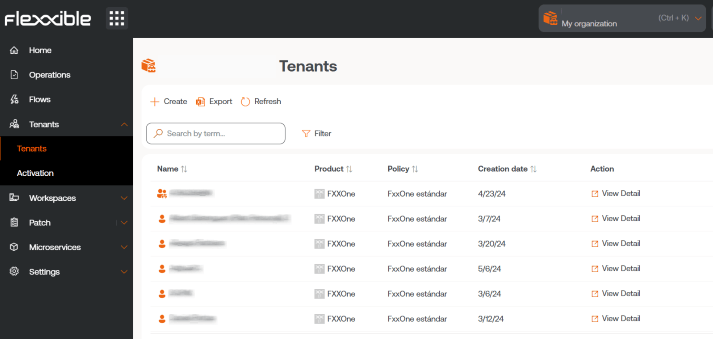 The **View details** button opens a form that lets you change the tenant's name and delete it.
The **New** button lets you create a new tenant; to do so, in addition to the above data, you must enter an email address, language, country, sector, product, and region. The **Export** button lets you download an Excel file with the list of current tenants. And **Reload** provides the option to refresh the table after entering new data.
### Tenant interface
If the user clicks on a tenant's name in the table, the interface redirects to the selected tenant's home page. This action is very useful because it speeds up consulting data from one organization or another.
The platform will not return to the default organization, even if the page is refreshed. To return, there are three options:
* **Ctrl + D** (**Cmd + D** on Mac).
* **Ctrl + K + O** (**Cmd + K + O** on Mac).
* Directly select the default organization in the organization selector, located in the upper right.
In the organization selector, you can differentiate tenants from sub-organizations. The latter are preceded by the name of the customer-type organization that manages them. For example: **Customer A > Sub-organization-01**.
## Activation
This section lets managed service providers (MSPs) evaluate the evolution of FlexxAgent installations or deployment in the customer-type organizations in which they have delegated administration.
The table in the list view shows the tenants' names. If it is a sub-organization, its name will be preceded by that of the organization managing it; for example: **Customer A > Sub-organization-01**. This naming convention is adopted because sub-organizations inherit the FlexxAgent configuration of the customer-type organization that manages them.
The table also indicates the Flexxible product held by the tenant, the corresponding organization type, and time indicators that help you understand the evolution of FlexxAgent adoption in the organization.
The time indicators offered by the table are **90 days ago**, **60 days ago**, **30 days ago**, **7 days ago**, and **Yesterday**. Each field specifies the number (units) of active agents at that given moment.
The **View details** button opens a form that lets you change the tenant's name and delete it.
The **New** button lets you create a new tenant; to do so, in addition to the above data, you must enter an email address, language, country, sector, product, and region. The **Export** button lets you download an Excel file with the list of current tenants. And **Reload** provides the option to refresh the table after entering new data.
### Tenant interface
If the user clicks on a tenant's name in the table, the interface redirects to the selected tenant's home page. This action is very useful because it speeds up consulting data from one organization or another.
The platform will not return to the default organization, even if the page is refreshed. To return, there are three options:
* **Ctrl + D** (**Cmd + D** on Mac).
* **Ctrl + K + O** (**Cmd + K + O** on Mac).
* Directly select the default organization in the organization selector, located in the upper right.
In the organization selector, you can differentiate tenants from sub-organizations. The latter are preceded by the name of the customer-type organization that manages them. For example: **Customer A > Sub-organization-01**.
## Activation
This section lets managed service providers (MSPs) evaluate the evolution of FlexxAgent installations or deployment in the customer-type organizations in which they have delegated administration.
The table in the list view shows the tenants' names. If it is a sub-organization, its name will be preceded by that of the organization managing it; for example: **Customer A > Sub-organization-01**. This naming convention is adopted because sub-organizations inherit the FlexxAgent configuration of the customer-type organization that manages them.
The table also indicates the Flexxible product held by the tenant, the corresponding organization type, and time indicators that help you understand the evolution of FlexxAgent adoption in the organization.
The time indicators offered by the table are **90 days ago**, **60 days ago**, **30 days ago**, **7 days ago**, and **Yesterday**. Each field specifies the number (units) of active agents at that given moment.
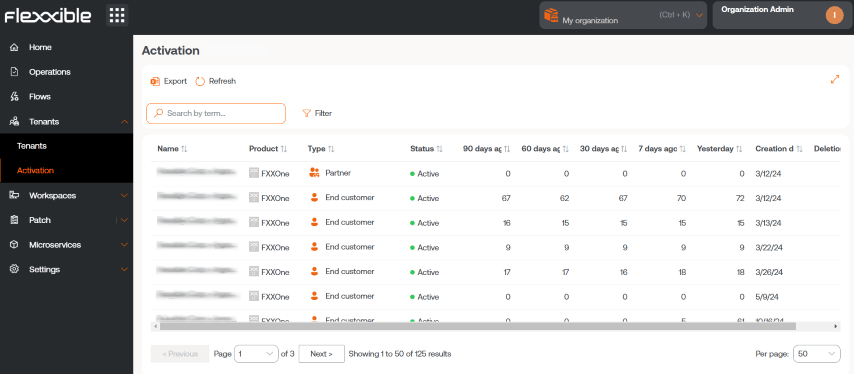 **Activation** also offers the option to search for tenants and the alternative to apply filters to the list of results, based on different parameters such as the company name, the product they have, and the type of organization they are. From **Export**, you can download the list view in Excel format.
In cases where the organization is composed of sub-organizations, in the activations view you can consult the activations by sub-organization in a simplified way, where the first line of the list will show the number of agents in the *parent* organization followed by the total sum of agents across all sub-organizations in parentheses, and in the lines below, the information for each sub-organization will be represented in **Parent organization** > **Sub-organization** format.
**Activation** also offers the option to search for tenants and the alternative to apply filters to the list of results, based on different parameters such as the company name, the product they have, and the type of organization they are. From **Export**, you can download the list view in Excel format.
In cases where the organization is composed of sub-organizations, in the activations view you can consult the activations by sub-organization in a simplified way, where the first line of the list will show the number of agents in the *parent* organization followed by the total sum of agents across all sub-organizations in parentheses, and in the lines below, the information for each sub-organization will be represented in **Parent organization** > **Sub-organization** format.